Why Do Banks Use Oracle Database? The Technology Behind Modern Banking
From a ₹10,000 transfer to a database failure, discover what happens behind the scenes when banks process your money.

You open your banking app.
You enter ₹10,000.
You tap Send.
A few seconds later:
“Transaction Successful.” ✅
Simple, right?
Not really.
Behind that tiny confirmation message, several systems have already worked together. Your identity was verified, your account was checked, your balance was validated, the transaction was processed, and the database had to make sure the money was deducted and credited correctly.
Now imagine doing this for millions of customers, often at the same time.
And then imagine the database crashing halfway through.
What happens to your ₹10,000?
That question explains why banking databases are built very differently from the database behind an ordinary application — and why enterprise platforms such as Oracle Database are used in many mission-critical financial environments.
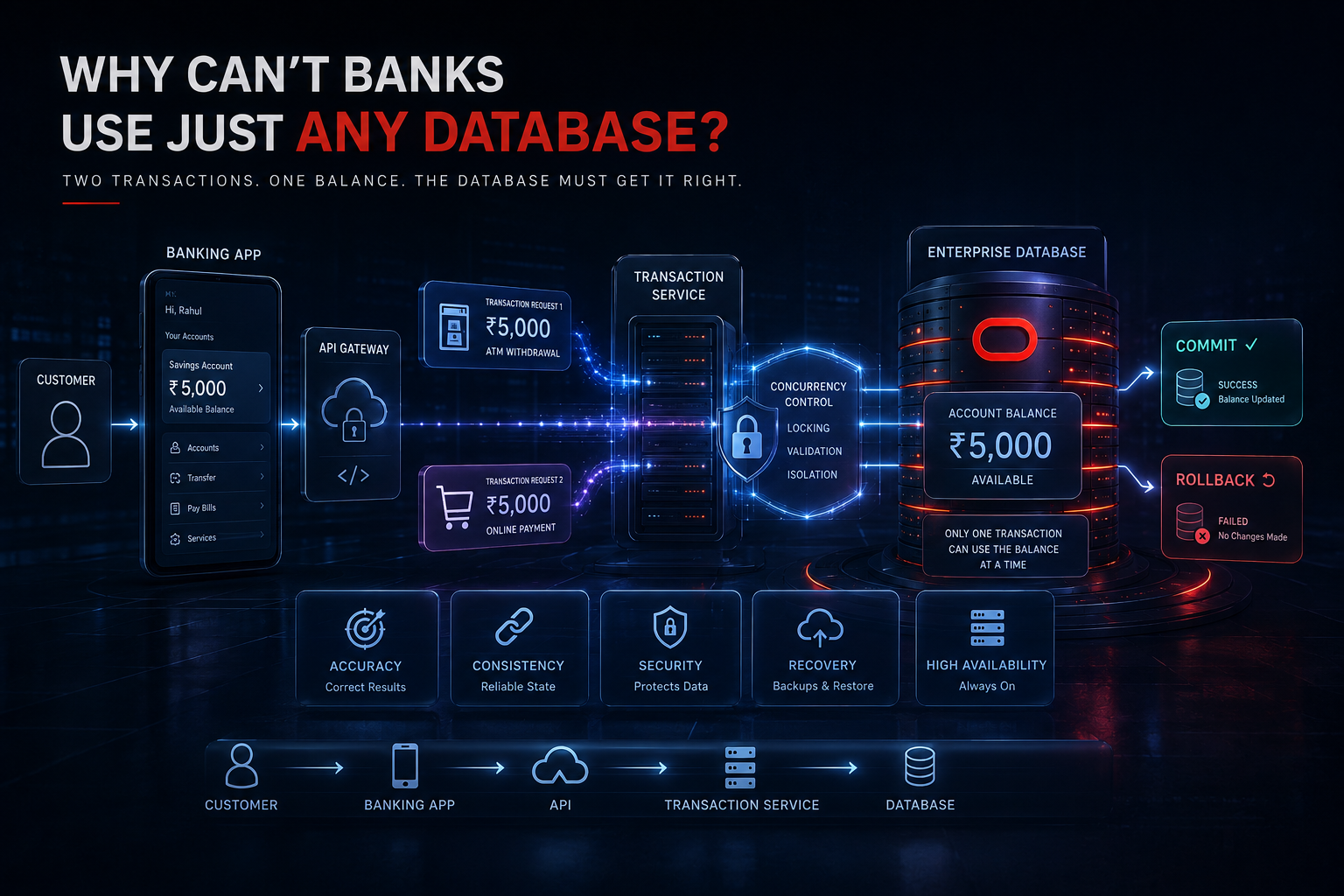
🏦 Why Can't Banks Use Just Any Database?
A banking database doesn't simply store names, account numbers and balances.
It has to keep financial transactions correct under extreme pressure.
Imagine you have ₹5,000 in your account.
Two transactions arrive almost simultaneously:
A ₹5,000 ATM withdrawal
A ₹5,000 online payment
Both systems check your balance at nearly the same time.
If the database doesn't properly coordinate those operations, both transactions could potentially attempt to spend the same money.
That's why banking systems care so much about:
Accuracy
Consistency
High availability
Security
Recovery
Concurrent transactions
Auditing
Scalability
A simplified flow looks like this:
Customer
   ↓
Banking App
   ↓
API
   ↓
Transaction Service
   ↓
Database
   ↓
Commit / Rollback
The database sits at the heart of this process.
And that brings us to one of the most important concepts in banking systems.
💳 What Actually Happens When You Transfer ₹10,000?
When you press Send, the system doesn't simply change a number in a table.
A simplified transaction might look like this:
User initiates transfer
        ↓
Authentication
        ↓
Account validation
        ↓
Balance check
        ↓
Transaction begins
        ↓
Debit Account A
        ↓
Credit Account B
        ↓
Commit
        ↓
Confirmation
Real banking architectures are much more complex, but there's one important idea here:
The debit and credit need to behave as one reliable transaction.
If ₹10,000 is removed from your account but never reaches the destination account, something has gone very wrong.
This is where ACID becomes important.
⚛️ Atomicity
The transaction behaves as one unit. It completes as intended or incomplete work can be rolled back.
🧩 Consistency
The database moves from one valid state to another.
🔒 Isolation
Transactions running at the same time shouldn't incorrectly interfere with each other.
💾 Durability
Once an appropriate transaction is committed, its changes should survive expected failures and recovery processes.
In other words, the database isn't just storing your transaction.
It's helping make sure the transaction actually means what you think it means.
But there's a much bigger problem.
What if the database crashes halfway through?
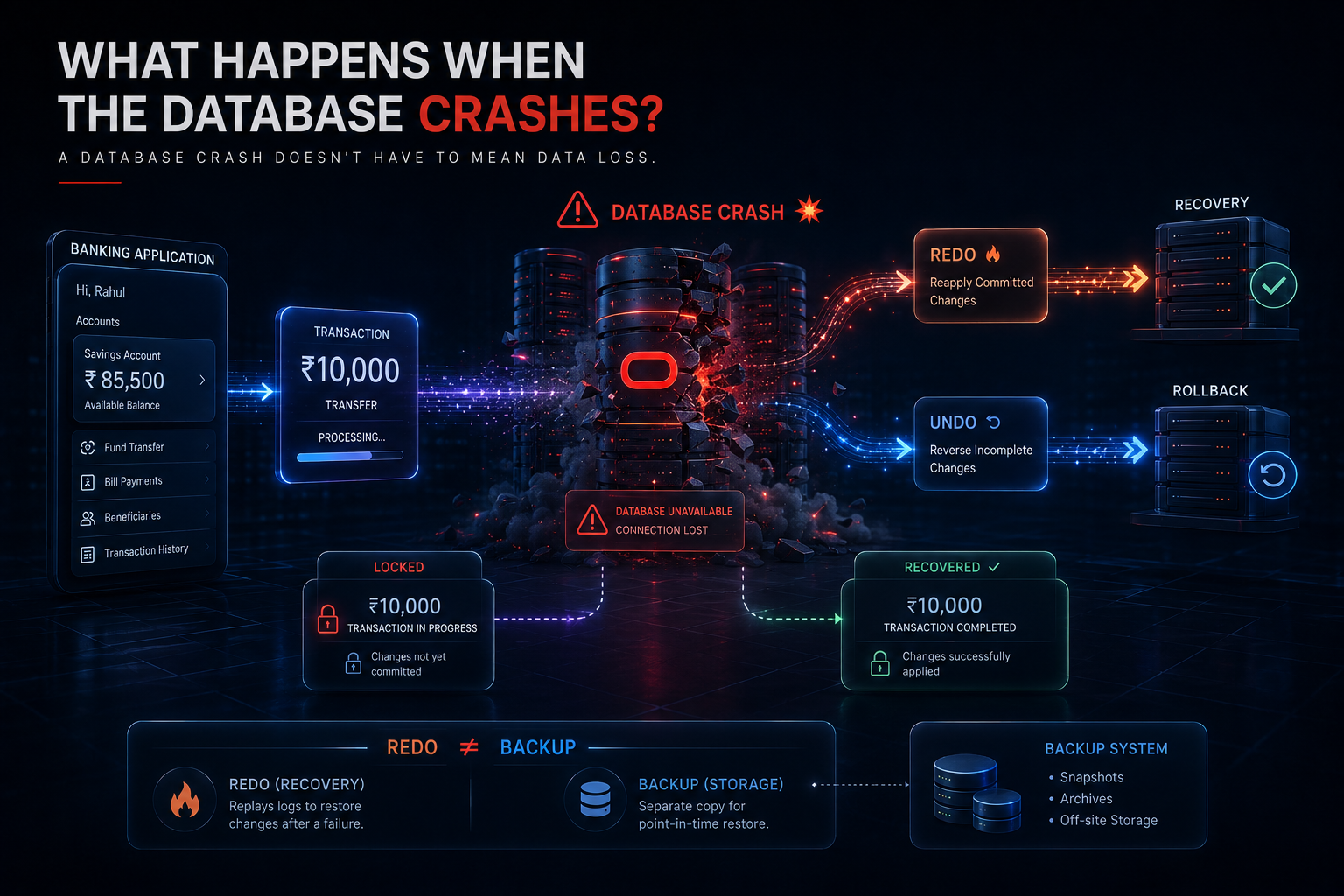
💥 What Happens When the Database Crashes?
Imagine you've just pressed Send.
The transaction has started.
The system is processing it.
Then—
💥 The database crashes.
Did your account get debited?
Did the other account get credited?
Should the transaction be repeated?
This is where database recovery becomes critical.
Oracle uses mechanisms such as redo and undo as part of its transaction and recovery architecture.
🔥 Redo
Redo information helps Oracle reproduce necessary changes during recovery.
↩️ Undo
Undo information helps roll back incomplete transactions and supports consistent reads.
Conceptually:
DATABASE CRASH 💥
       ↓
      REDO
       ↓
    RECOVERY


INCOMPLETE TRANSACTION
       ↓
      UNDO
       ↓
    ROLLBACK
One important distinction:
Redo logs are not backups.
They are part of Oracle's transaction and recovery architecture. A proper banking environment still needs backups and disaster-recovery strategies.
The bigger idea is this:
A good database doesn't only need to work when everything is working.
It needs to have mechanisms for dealing with failure.
⚡ Banks Can't Simply Say “The Database Is Down”
Imagine your banking app being unavailable for five minutes.
Annoying?
Absolutely.
Now imagine critical banking infrastructure being unavailable.
ATMs could be affected.
Card transactions could be interrupted.
Transfers could fail.
Internal banking operations could be disrupted.
For mission-critical systems, availability matters enormously.
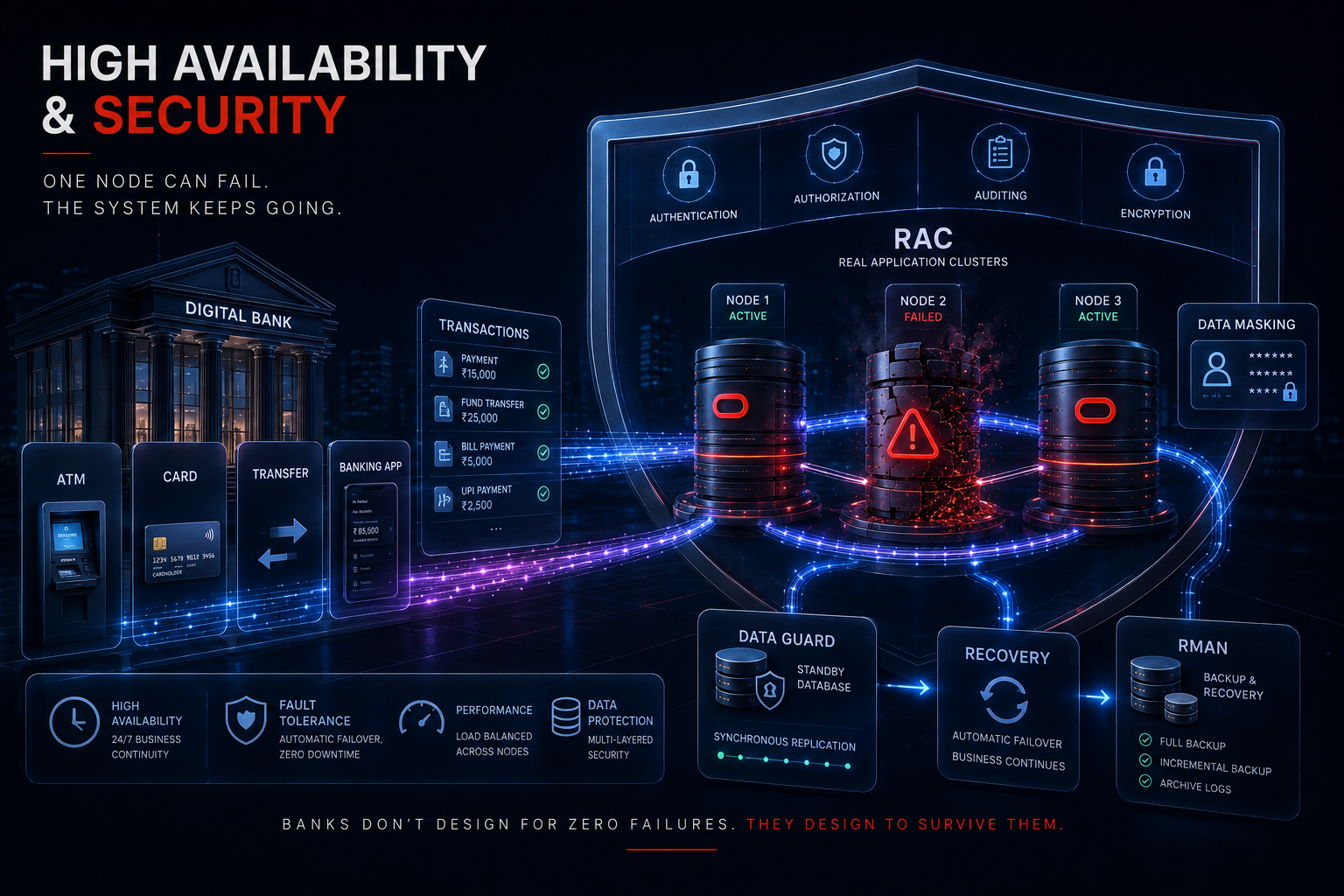
This is one reason Oracle has technologies designed around high availability and scalability.
For example, Oracle Real Application Clusters (RAC) allows multiple database instances to work with the same database, providing an architecture designed for high availability and scalability.
Other technologies include:
RAC — clustered database architecture
Data Guard — availability and disaster-recovery capabilities
Application Continuity — helps applications recover from certain outages
RMAN — backup and recovery tooling
The goal isn't to pretend failures don't exist.
It's to design systems that can handle them.
🔐 What About Security?
Banking data is extremely valuable.
So the question isn't simply:
“Where is the data stored?”
It's also:
“Who can access it, what can they do, and can we prove what happened?”
A banking system may need to control:
🔐 Authentication Who are you?
🛡️ Authorization What are you allowed to access?
📋 Auditing What happened and when?
🔒 Encryption How is sensitive information protected?
🎭 Data masking How can sensitive information be hidden when full data isn't required?
Oracle provides a broad range of security and auditing capabilities.
But there's an important caveat:
No database is automatically secure.
Security also depends on correct configuration, access controls, architecture, monitoring and operational practices.
📈 What Happens When Millions of Transactions Arrive?
You're not the only person transferring money.
At the same moment, someone else could be:
Paying a credit-card bill
Withdrawing cash
Receiving a salary
Paying a merchant
Checking their balance
Making another transfer
Behind the scenes, there may also be fraud detection, reporting, risk calculations and other internal workloads.
This creates enormous concurrency.
And database performance isn't simply about asking:
“Which database is fastest?”
Performance depends on:
Query design
Indexes
Memory
Hardware
Storage
Network
Application architecture
Workload patterns
A powerful database with poor queries can still perform badly.
The database is only one part of the larger system.
🧠 If PostgreSQL Exists, Why Not Just Switch?
This is where things become interesting.
If PostgreSQL and other modern databases are powerful, why wouldn't a bank simply replace Oracle?
Because changing a database at enterprise scale isn't as simple as:
Oracle
  ↓
PostgreSQL
A large organization may have years of infrastructure built around its existing database:
SQL and PL/SQL code
Stored procedures
Applications
APIs
Reporting systems
Security controls
Monitoring
Integrations
Operational processes
Staff expertise
Testing
Compliance requirements
The database is often deeply embedded in the architecture.
So the question isn't:
“Which database is better?”
It's:
“Which database makes sense for this workload, architecture, cost, ecosystem and organization?”
That's why Oracle, PostgreSQL, MySQL, SQL Server, Db2 and other databases can all have legitimate use cases.
For some enterprise workloads, Oracle may be a strong fit.
For modern open-source applications, PostgreSQL may be attractive.
For many web workloads, MySQL may be a practical choice.
There is no universal winner.
🎯 So, Why Do Banks Use Oracle Database?
Now let's return to that ₹10,000.
You tapped Send.
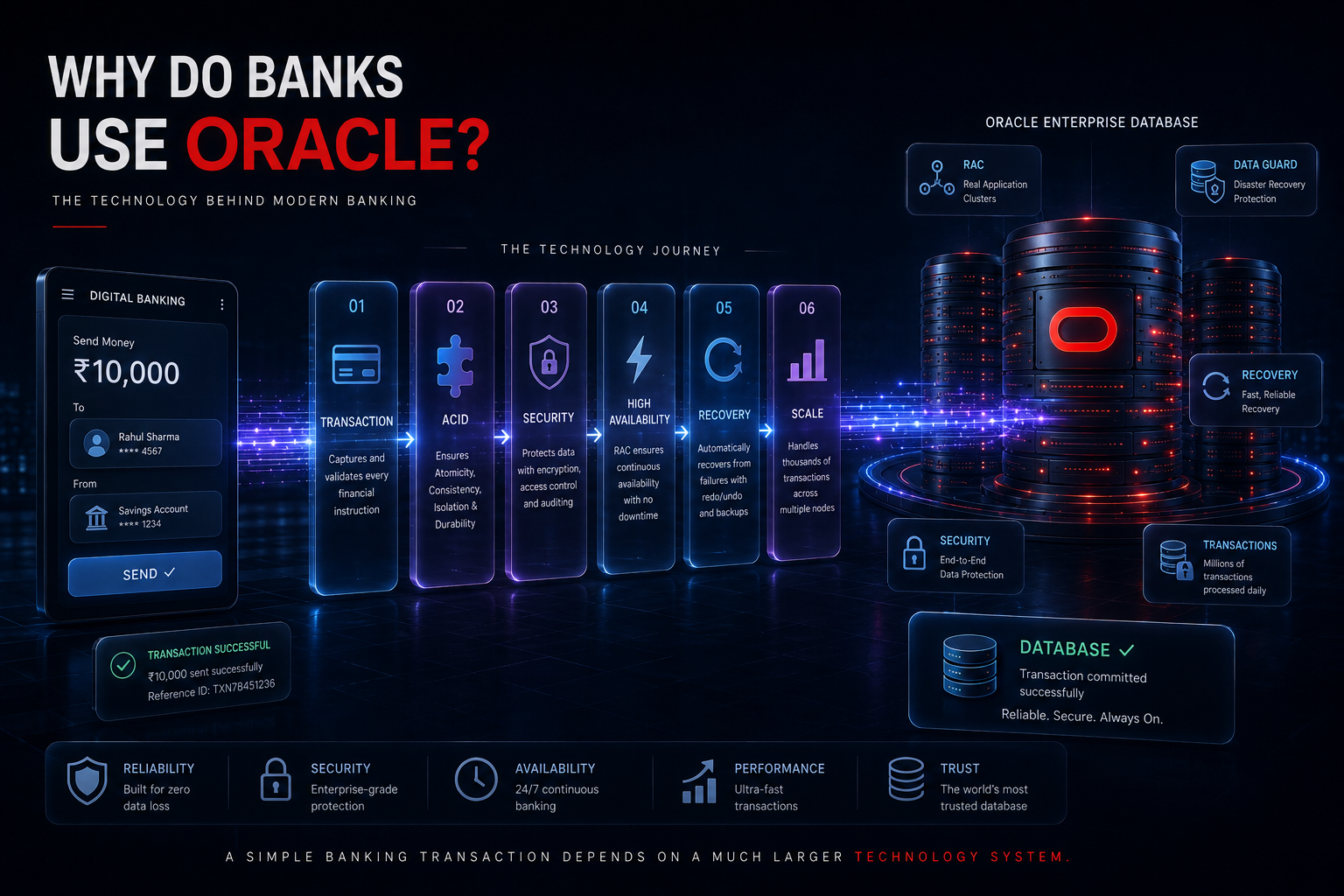
Behind that single action was a much larger system:
💳 TRANSACTION
      ↓
🧩 ACID
      ↓
🔐 SECURITY
      ↓
⚡ HIGH AVAILABILITY
      ↓
🔄 RECOVERY
      ↓
📈 SCALE
      ↓
🗄️ DATABASE
So, why do banks use Oracle Database?
Not simply because it can store data.
Oracle is attractive for certain mission-critical environments because it provides capabilities around transaction processing, recovery, high availability, security, scalability and enterprise operations.
But it's important not to turn that into an absolute statement.
Not every bank uses Oracle.
Financial institutions use a mixture of technologies, including Oracle, IBM Db2 and mainframe systems, SQL Server, PostgreSQL, proprietary platforms and others.
The right choice depends on the organization's requirements and architecture.
💡 The Final Takeaway
The next time you tap “Send Money,” remember that the confirmation appearing on your screen is only the visible part of the process.
Behind it are databases, APIs, transaction systems, security controls, recovery mechanisms and infrastructure designed to answer one critical question:
What happens if something goes wrong?
Because in banking, processing a transaction when everything works is only half the challenge.
The real engineering begins when two transactions collide, a server fails, or a database crashes halfway through.
And that's why a banking database isn't simply a place where money-related data is stored.
It's part of the system that makes financial transactions trustworthy.
- #oracle
- #oracle-database
- #banking-technology
- #database
- #sql
- #fintech
- #system-design
- #backend
- #backend-development
- #enterprise-technology
- #financial-technology
- #database-security
- #high-availability
- #database-recovery
- #oracle-rac
- #oracle-database-for-banking
- #why-banks-use-oracle
- #oracle-banking-database
- #oracle-database-banking
- #banking-database-technology
About the author
- I am a Software Engineer and Cybersecurity Researcher with over 4.5 years of hands-on experience through internships and freelance work. I specialize in building scalable, high-performance web applications and designing secure, reliable systems. As a record holder recognized by the International Book of Records and India Book of Records, I share technical knowledge through blogs, reaching a professional network of 26K+ followers. On Hashnode, I share insights and practical experiences in software engineering and cybersecurity.
Comments
Join the discussionNo comments yet. Be the first to comment.